
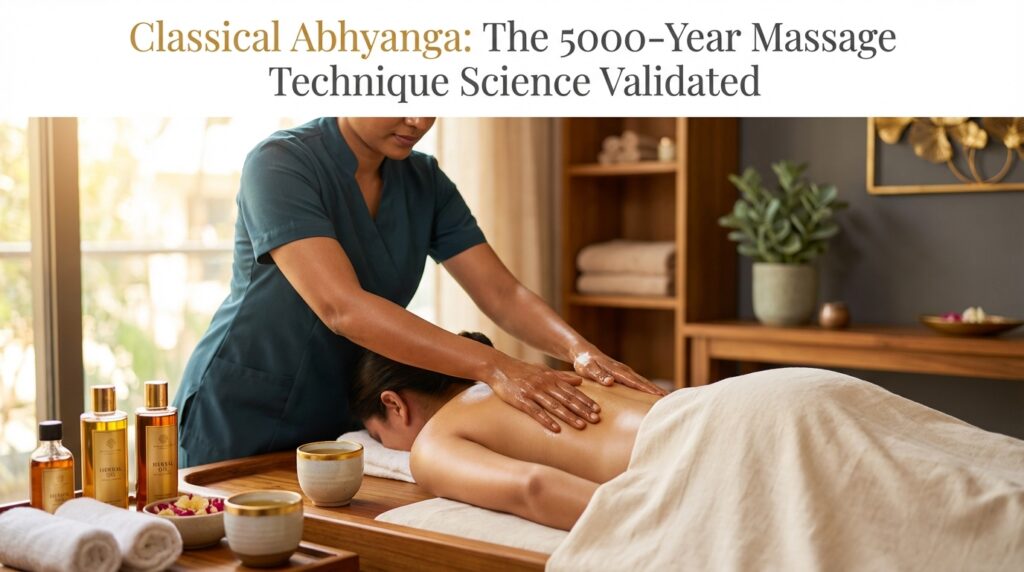
Not all massage wisdom is 5 years old. Some is 5,000.
If you are someone who reads ingredient labels, asks questions before booking a treatment, and believes that real wellness runs deeper than a good nap — you already sense that Classical Abhyanga is different. You may have come across it in an Ayurvedic text, heard it mentioned by a practitioner, or simply felt that the standard spa menu was missing something more rooted, more intentional. That instinct is worth honouring.
Classical Abhyanga Madiwala is what this guide is about. Not a generic overview of warm oil massage, but a proper, honest exploration of what Abhyanga actually is, why it has survived five millennia while wellness trends have come and gone, and what modern science now confirms about its mechanisms. By the time you finish reading, you will know exactly what happens to your body during an Abhyanga session, how it compares to Western massage modalities, and how the Visrama package at Southern Spa brings this ancient practice into a carefully curated 90-minute experience in the heart of Madiwala.
What Classical Abhyanga Actually Is — And Why It Has Lasted 5,000 Years
Abhyanga is not simply “oil massage.” That description is technically accurate in the same way that describing a raga as “music” is accurate — true, but missing everything that matters.
The word Abhyanga comes from Sanskrit: abhi (towards) and anga (limb or body). In Ayurvedic tradition, the practice is described in foundational texts including the Charaka Samhita and Ashtanga Hridayam, both composed well over two thousand years ago. These texts did not treat Abhyanga as a luxury or an occasional indulgence — they prescribed it as a daily practice (Dinacharya) for maintaining health, preventing disease, and sustaining vitality across a lifetime. The Charaka Samhita states that regular Abhyanga produces a body that is resistant to injury and fatigue, with healthy skin and strong joints — language that reads less like ancient poetry and more like a wellness prescription that holds up remarkably well under modern scrutiny.
The philosophical foundation of Abhyanga sits within Ayurveda’s understanding of the body as an intelligent system governed by three fundamental energies, or doshas: Vata (air and space), Pitta (fire and water), and Kapha (earth and water). When these energies fall out of balance — which happens easily under the pressures of a demanding career, disrupted sleep, poor digestion, and the relentless pace of urban life — the body begins to signal its distress through tension, dryness, fatigue, joint discomfort, anxiety, and reduced immunity. Abhyanga works not by suppressing these signals but by addressing the underlying imbalance that produced them.
What makes Abhyanga structurally different from other massage modalities is that the strokes are not random. They follow specific energy pathways (srotas) that run through the body, and they are applied in a particular sequence — from the head downward, with deliberate attention to the joints, the long bones, and the marma points that we will explore in the next section. The oil used is not decorative — it is medicinal. Sesame oil is traditionally considered the gold standard for Vata-pacifying Abhyanga because of its deeply penetrating molecular structure, though oils may be selected based on dosha constitution. The oil is warmed before application, which opens the skin’s pores and allows the active compounds to begin working at a subcutaneous level before the strokes even begin.
This is the architecture of a practice that has endured across cultures, centuries, and civilisations. Not because people in ancient India lacked alternatives, but because it worked. And because, as science is now confirming, the reasons it worked then are the same reasons it works now.
The Mechanism Explained: Doshas, Marma Points, and What Happens Beneath the Skin
Understanding how Classical Abhyanga works requires looking at three interconnected systems: the dosha framework, the marma point network, and the physiological responses that modern science can now measure.
Dosha Balancing Through Touch and Oil
In Ayurvedic physiology, Vata dosha governs movement — including the movement of nerve impulses, blood, lymph, and cellular waste. When Vata is elevated (which is extremely common in people living high-stimulus, high-screen, high-deadline lives), the body becomes dry, erratic, and anxious. Joints crack. Sleep becomes light and broken. The mind races. Abhyanga is primarily a Vata-pacifying practice: the warmth of the oil, the rhythmic continuity of the strokes, and the grounding weight of physical contact all communicate safety and stillness to an overactivated nervous system. Pitta and Kapha imbalances are addressed through oil selection and stroke variation — which is why a properly conducted Abhyanga begins with a brief consultation, not simply with the client lying face-down.
Marma Points: Ayurveda’s Pressure Map
The body, in Ayurvedic anatomy, contains 107 marma points — junctions where muscle, bone, ligament, vein, and joint meet, and where prana (life force) is concentrated. Stimulating these points during Abhyanga releases blocked energy, improves organ function, and communicates directly with the nervous system. Several of the most important marma points are located in areas that receive sustained attention during Abhyanga: the crown of the head (Adhipati), the heart centre (Hridaya), the base of the spine (Katikataruna), and the soles of the feet (Talhridaya). Modern anatomy would recognise many of these locations as nerve plexuses and fascia junctions — places where therapeutic pressure produces measurable systemic effects. The ancient mapping and the modern anatomy are describing, it turns out, the same terrain.
The Lymphatic Connection
One of the most clinically significant mechanisms of Abhyanga is its effect on the lymphatic system — a network that has no pump of its own and relies entirely on muscular movement and external stimulation to circulate. Rhythmic, directional strokes applied along the body’s natural lymphatic drainage pathways encourage the movement of lymph fluid, supporting the removal of metabolic waste, pathogenic material, and inflammatory byproducts from the tissues. massage therapy research from Madiwala and beyond increasingly validates this mechanism — the same pathway by which Abhyanga was described to support immunity and detoxification in texts written long before the lymphatic system was formally mapped in Western medicine.
Modern Science Weighs In: What Research Now Confirms
The question “Is Ayurveda scientific?” deserves a serious answer, not a dismissive one in either direction.
A 2011 study published in the Journal of Alternative and Complementary Medicine found that a single Abhyanga session produced measurable reductions in heart rate, blood pressure, and anxiety scores compared to a control group receiving rest. A 2014 study in Evidence-Based Complementary and Alternative Medicine found that regular Abhyanga reduced perceptions of fatigue and improved sleep quality — outcomes that map precisely to what the classical texts promised for regular practice. Research published in the International Journal of Ayurveda Research has documented the skin-penetrating properties of sesame oil at a molecular level, confirming that the active compounds — sesamin, sesamolin, and vitamin E — do not merely sit on the skin’s surface but penetrate the dermal layer within minutes of application.
The nervous system effects are perhaps the most compelling area of modern validation. The slow, rhythmic, continuous strokes of Abhyanga activate the parasympathetic nervous system — the branch responsible for rest, digestion, repair, and immune function — and suppress the sympathetic (fight-or-flight) response that most people in modern cities are running on as a default setting. Research measuring salivary cortisol levels before and after Abhyanga has shown statistically significant reductions in this primary stress hormone. The body, it turns out, cannot tell the difference between ancient healing intention and a measurable biochemical shift. Both happen simultaneously.
Joint lubrication is another area where the science aligns with tradition. The warm oil penetrates the periarticular tissue — the connective tissue surrounding joints — reducing friction, supporting synovial fluid production, and easing the kind of stiffness that accumulates in people who sit at desks for eight to ten hours a day. If you commute via Silk Board or spend your evenings hunched over a laptop in Koramangala, this particular benefit is worth paying attention to. understanding whether deep tissue or a classical approach suits your body depends partly on whether your issue is muscular tension or deeper joint and tissue dehydration — and Abhyanga addresses the latter in ways that other modalities do not.
Abhyanga vs Western Massage Modalities: An Honest Comparison
Your body doesn’t need another massage. It needs the technique that’s been working for 5 millennia.
This is not a rejection of Swedish or Deep Tissue massage — both are genuinely effective within their own frameworks. But they were designed for different purposes, and understanding the distinction helps you choose the right treatment for the right moment.
the difference between Swedish and Deep Tissue is primarily about pressure and target tissue: Swedish uses lighter, flowing effleurage strokes to promote circulation and surface-level relaxation, while Deep Tissue applies slow, concentrated pressure to reach the deeper muscle layers and fascia. Both are Western modalities developed in the 18th and 20th centuries respectively — effective, evidence-backed, and widely practised.
Abhyanga operates from an entirely different philosophical and physiological starting point. Where Swedish massage prioritises muscular relaxation and Deep Tissue targets chronic muscular adhesions, Abhyanga works systemically — treating the body as a connected whole rather than a collection of muscle groups. The oil is not a lubricant; it is a co-therapist. The strokes are not comfort strokes; they are directional communications to the lymphatic and nervous systems. The duration of the session is not simply “time on the table” — it is calibrated to allow the oil sufficient contact time to penetrate and begin its work.
In practical terms, this means Abhyanga is particularly well-suited for: people experiencing systemic fatigue rather than localised muscle soreness; those with dry, depleted skin and joints; anyone whose nervous system feels chronically overstimulated; people managing mild immunity issues or recurring illness; and anyone with a genuine interest in addressing the root cause of their discomfort rather than managing its symptoms. If you are someone who has tried Swedish massage and found it pleasant but temporary, or Deep Tissue and found it effective but brutal, Abhyanga may be the modality that has been missing from your wellness practice. You can explore the full range of massage and wellness treatments available at Southern Spa to find what your body genuinely needs.
The Visrama Package: Classical Abhyanga as a Complete Wellness Ritual
At Southern Spa in Madiwala, Classical Abhyanga is offered as the centrepiece of the Visrama package — a 90-minute wellness ritual that honours the traditional sequence of Ayurvedic treatment by pairing the massage with two complementary therapies.
Visrama means rest, cessation, and deep settledness in Sanskrit. It is a precisely chosen name.
The experience unfolds in three stages:
Stage One: Classical Abhyanga Massage. Your therapist begins with warm herbal oil applied in broad, rhythmic strokes along the body’s energy lines. The sequence moves with intention — from the head and neck, along the spine, across the limbs, and toward the feet — stimulating marma points and encouraging lymphatic drainage. The oil is chosen to suit your constitution and the season. The pressure is firm enough to be felt deeply, gentle enough to keep the nervous system in receptive rather than reactive mode. This is not a passive experience; you will feel the treatment working.
Stage Two: Steam Bath. Following the Abhyanga, the steam bath continues the detoxification process by opening the pores further and encouraging the herbal oil to penetrate more deeply while simultaneously encouraging the body to release heat-mobilised toxins through perspiration. In traditional Panchakarma protocol, this stage is called Swedana and is considered inseparable from the oil massage that precedes it. The warmth also sustains the parasympathetic state the massage created — rather than returning you abruptly to wakefulness, it extends the stillness.
Stage Three: Herbal Body Scrubbing. The ritual closes with a herbal body scrub that removes the oil residue and the loosened surface skin cells, revealing skin that feels noticeably different — not simply cleaner, but genuinely renewed. The scrub ingredients are plant-based and traditionally selected, completing a cycle of nourishment, heat-activation, and renewal that mirrors the classical Ayurvedic approach to physical purification. If you are curious about the standalone benefits of this practice, the Soul Mate package also incorporates herbal body scrubbing as part of its 90-minute sequence.
The Visrama concludes with herbal tea — warm, grounding, and chosen to support the body’s post-treatment state. You leave not just relaxed but reset.
📲 Experience 5,000 years of wellness wisdom at Southern Spa, Madiwala. Call or WhatsApp +91 91086 12001 to book your Visrama session.
Why Southern Spa in Madiwala for Classical Abhyanga
For someone who approaches wellness with genuine curiosity and intention, where you receive Abhyanga matters as much as the treatment itself. The quality of the oil, the training of the therapist, the environment in which you receive the treatment — these are not peripheral concerns. They are the treatment.
Southern Spa is located on the 2nd Floor of Market Square Mall, Hosur Road, directly opposite the Madiwala Traffic Police Station. If you live or work in Koramangala, BTM Layout, HSR Layout, Jayanagar, Bommanahalli, or Electronic City, you are within a 15-minute drive of a properly conducted Classical Abhyanga — no need to cross the city or plan around a distant destination. As a spa in Madiwala, Southern Spa sits at the geographic and practical centre of Bengaluru’s southern wellness corridor.
Opened in April 2024 and carrying 57+ Google reviews, Southern Spa has been built around a specific philosophy: that genuine wellness requires the right technique, the right therapist, and the right environment — not just a room and a table. The Visrama package is delivered by therapists trained in Classical Abhyanga as a complete system, not adapted from a generic oil massage protocol. The herbal oils, the steam, and the body scrub are curated to work together as a single therapeutic sequence. If you are interested in exploring how Southern Spa approaches traditional wellness, the philosophy is consistent across every treatment on the menu.
For those who appreciate the sensory environment as part of the experience, the Southern Spa Madiwala on Google Maps listing shows the space and guest photographs. Walk-ins are welcome subject to availability, though booking in advance is recommended for the Visrama package to ensure therapist availability and full session time.
📲 Visit Southern Spa, 2nd Floor, Market Square Mall, Hosur Road, Madiwala, Bengaluru 560068. Book Visrama: +91 91086 12001 | WhatsApp
Frequently Asked Questions
What makes Classical Abhyanga different from a standard oil massage at a spa?
Classical Abhyanga follows a specific sequence of strokes mapped along Ayurvedic energy pathways and marma points, using warm herbal oil selected for its therapeutic properties. A standard oil massage may use oil as a lubricant for relaxation strokes; Abhyanga uses it as an active ingredient in a system designed to balance the nervous system, stimulate lymphatic drainage, and nourish joint tissue. At Southern Spa, the Visrama package delivers Abhyanga as part of a complete three-stage Ayurvedic ritual — not as a standalone massage with oil added.
I have a Vata constitution and tend toward anxiety and joint dryness — is Abhyanga appropriate for me?
Abhyanga is considered one of the most effective Ayurvedic practices for Vata imbalance specifically. The warm oil, the rhythmic continuity of the strokes, and the grounding nature of the practice are designed to pacify elevated Vata — reducing anxiety, lubricating dry joints, and calming an overactive nervous system. If you have specific health conditions, it is always advisable to consult your Ayurvedic practitioner, but for most people with Vata tendencies, Abhyanga is deeply restorative. Your Southern Spa therapist can discuss oil preferences and stroke depth before your session begins.
How do I book the Visrama package at Southern Spa Madiwala?
You can book via WhatsApp at +91 91086 12001 or call the same number directly. Southern Spa is open seven days a week, and advance booking is recommended for the Visrama package to secure your preferred time. Walk-ins are welcome subject to availability. The spa is located on the 2nd Floor of Market Square Mall, Hosur Road, Madiwala — easily accessible from Koramangala, BTM Layout, and HSR Layout.
Can I combine Classical Abhyanga with other treatments at Southern Spa?
The Visrama package already pairs Classical Abhyanga with a Steam Bath and Herbal Body Scrubbing in a single 90-minute session — which reflects the traditional Ayurvedic sequence of oil treatment, heat application, and purification. If you are exploring Ayurvedic wellness more broadly and would like to understand how aromatherapy oils and herbal ingredients work as part of a wider wellness practice, how aromatherapy actually works provides useful context on essential oil mechanisms. Your therapist at Southern Spa can also advise on complementary treatments based on your current wellness goals.
Final Thoughts
Five thousand years is a long time for a technique to survive. Trends do not last five thousand years. Marketing does not last five thousand years. What lasts is efficacy — the direct, repeatable experience of a body that feels genuinely better after the treatment than it did before. Classical Abhyanga has that record.
If you have been drawn to Ayurvedic wellness — reading about it, researching it, perhaps practising elements of it at home — receiving a properly conducted Abhyanga is the logical next step. Not because it will complete your knowledge of the system, but because knowledge of Abhyanga held only in the mind is a fraction of what Abhyanga held in the body actually delivers.
The Visrama package at Southern Spa in Madiwala is where that experience becomes real. Ninety minutes. Ancient technique. Modern validation. A 15-minute drive from wherever you are in Bengaluru’s south zone.